関数による初期化
2015年10月9日
はじめに
関数による初期化について。
使用バージョン
OpenFOAM 2.4.0
関数による初期値の設定
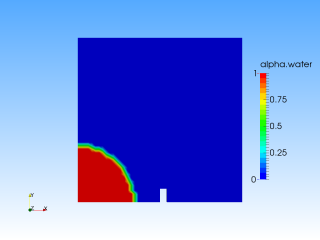
関数により初期値を設定するには、codeStream を用いる。例として interFoam のチュートリアルケース damBreak における水の液相率 alpha.water の設定を考える。ここでは原点を中心とした半径 0.2 の円の内部に初期の液相率を与えるものとする。alpha.water の internalField で以下のように設定する。
0/alpha.water
internalField   #codeStream
{
    codeInclude
    #{
        #include "fvCFD.H"
    #};

    codeOptions
    #{
        -I$(LIB_SRC)/finiteVolume/lnInclude \
        -I$(LIB_SRC)/meshTools/lnInclude
    #};

    code
    #{
        const IOdictionary& d = static_cast<const IOdictionary&>(dict);
        const fvMesh& mesh = refCast<const fvMesh>(d.db());
        scalarField alpha(mesh.nCells(), 0.);

        forAll(alpha, i)
        {
            const scalar x = mesh.C()[i][0];
            const scalar y = mesh.C()[i][1];
            const scalar r = sqrt(x*x + y*y);

            if (r < 0.2)
            {
                alpha[i] = 1.;
            }
        }

        alpha.writeEntry("", os);
    #};
};
controlDict でライブラリを指定 (ParaView 用)。
libs
(
    "libfiniteVolume.so"
);
つぎのような初期液相率分布が得られる。
関数による境界条件の設定
codeStream により、分布を持たせた境界条件を設定することもできる。simpleFoam のチュートリアルケース pitzDaily で流入速度に分布を持たせた例を示す。
0/U
    inlet
    {
        type            fixedValue;
        value           #codeStream
        {
            codeInclude
            #{
                #include "fvCFD.H"
            #};

            codeOptions
            #{
                -I$(LIB_SRC)/finiteVolume/lnInclude \
                -I$(LIB_SRC)/meshTools/lnInclude
            #};

            code
            #{
                const IOdictionary& d = static_cast<const IOdictionary&>(
                    dict.parent().parent()
                );
                const fvMesh& mesh = refCast<const fvMesh>(d.db());

                const label id = mesh.boundary().findPatchID("inlet");
                const fvPatch& patch = mesh.boundary()[id];
                vectorField U(mesh.boundary()[id].size(), vector(0, 0, 0));

                const scalar pi = constant::mathematical::pi;

                const scalar ux = 10.;
                const scalar ymax = 0.0245;

                forAll(U, i)
                {
                    const scalar y = patch.Cf()[i][1];
                    U[i] = vector(ux*sin(pi*y/ymax), 0., 0.);
                }

                U.writeEntry("", os);
            #};
        };
    }
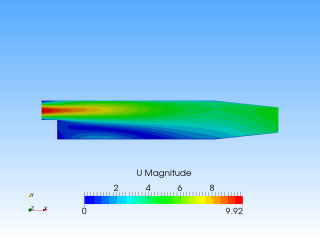
コードの中で境界名 ("inlet") が指定されていることに注意。これは codeStream の一例を示しているだけで、もし同様のことを行うなら境界タイプ codedFixedValue を使うのが素直である (その場合、少しだけコードが短くなる)。